In this part of my blog, I want to explain some archaeological terms and also describe some of the ingredients I use. Some ingredients we use today for a lot of western recipes were surprisingly uncommon in the past. Others were used much earlier than one would have thought. All terms I explain belwo are special, but alsow important for my cooking in some way.
Akkadian: Semitic language, used in Mesopotamia from 2300 BC until the 1st century AD, known from cuneiform inscriptions, such as the Yale Culinary Tablets.
Babylon: A famous city that existed between the 3rd millennium BC and the time of Alexander the Great, close to the modern city of Baghdad.
Babylonia: Some city-states under the reign of the king of Babylon, in the country known today as Iraq.
Beer: First archaeological evidence around 11,000 BC in the Levant, when humans first started growing crops in the Near East. Around 4000 BC the production of beer increased to large amounts.
Bronze Age: The time between ca. 3000 BC and the late 2nd millennium BC in Eurasia, when the use of bronze, an alloy of copper and tin, became an important part of peoples’ lives.
Cuneiform: A writing system, mostly used for writing on clay tablets in the ancient Near East. With cuneiform writing, many Near Eastern languages could be written, e.g. Sumerian, Akkadian and Assyrian.
Leek: As hieroglyphic texts and images show, leek was known as a vegetable in Egypt since the 3rd millennium BC. It was also used as part of bouquets for graves. The plant grows in humid areas and soils rich in humus and can be harvested in spring.
Lentil: The oldest known finds of lentils are from the Eastern Mediterranean region and date back to the Stone Age. The consumption of lentils spread with the advent of farmers in the region and reached Greece in the late 7th millennium BC. There are various kinds that can be harvested in August and September. When dried, they can be stored for a long time.
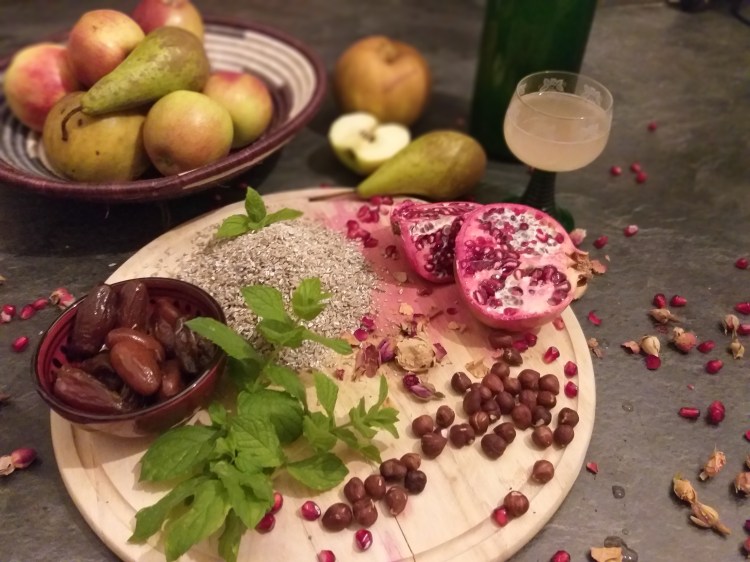
Mint: There are various kinds of mint, which grow all over the Eastern Mediterranean. The eatable leaves grow all year long and can be stored in a dried form for a long time.
Onion: The earliest use of this plant dates back to 2,700 BC in Egypt based hieroglyphic inscriptions, depictions and archaeological findings. Depending on the type of onion, they can be harvested around June and September.
Tablets: With regard to the Bronze Age, we use this term for small clay tablets, which are covered by texts written in cuneiform letters. They were pressed into the clay with a wedge-tipped little stick, when the clay was still soft. We have tablets, which tell us about Bronze Age myths, administration, trade and, of course, recipes.
Wheat: This is an umbrella term for related cereals such as einkorn, emmer, spelt, bread wheat and others. First wheats started to be cultivated around 10,000 before present in the Near East. The cultivation of wheat is ambitious in comparison to barley, because it only grows well on a ground that is rich in humus and chalk and poor in salt and takes rather long to ripen.
Yale Culinary Tablets: Three cuneiform tablets from Babylonia with various recipes for feeding the upper classes and the gods. They are currently housed in the collection of Yale University (US) and that is why they are called “Yale Culinary Tablets”. Unfortunately, the exact place of finding of these super interessting tablets remains unknown.
 Luise´s Bronze Age Feast